Forward by Peter A Renzetti
“I never thought I would be saying this to you, but the door is now open.
You can forge hollow tube — on your anvil, with your tools.
All you have to do is walk through that door and open your mind to Thinking in Tube.”
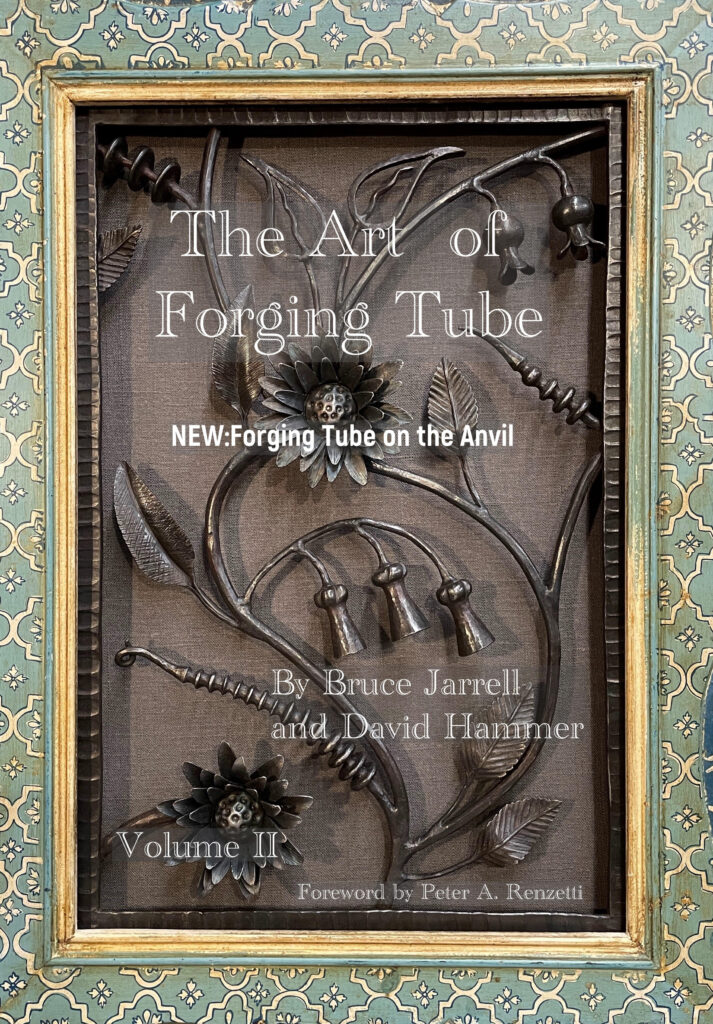
The most important skill in working with hollow round tube isn’t strength or equipment, it’s mindset. To work successfully with tube, you must let go of traditional blacksmithing habits and begin to Think in Tube.
Thinking in Tube means shifting your focus from moving solid masses of steel to shaping a thin, responsive line of material—the tube wall itself. Instead of forcing bulky bar stock into submission, you are guiding a delicate cross section up, down, in, or out. In many ways, this approach is similar to repoussé (the French term for “pushing back”), where flat metal is reshaped with hand tools by manipulating a narrow line rather than displacing a thick block of material.
With tubing, however, that concept expands. A tube wall consists of two parallel lines, both walls of the tube—that can be reshaped together to create remarkable forms. Unlike repoussé, where metal is worked against pitch or lead, tube forging pushes the surface inward against empty space. You are forging against air. That hollow lumen gives the metal freedom to move in surprising ways, allowing the tube to remain hollow even as it transforms.
This is where magic happens. By forging on air, you can use simple hammers and anvil tooling to create perfect symmetrical forms like flowers—or bold, asymmetrical shapes such as zigzag cacti, seed pods, and spiral screws. Throughout this book, cross-sectional images reveal what’s happening inside the tube after forging, offering invaluable insight into how the metal flows and behaves. These visual cues deepen your understanding and strengthen your ability to truly Think in Tube.
Since the release of The Art of Forging Tube, countless new techniques have been discovered. This second volume dives deeper into the expanding possibilities of tube forging using primarily hand tools. Anyone with a modestly equipped shop—an anvil, vises, drill press, band saw, welder, and basic hand tools—can begin exploring these methods and developing their own forms.
As you turn the pages, you’ll see the evolution of simple dies and shaped tools, easily fabricated from mild steel and designed for hand use at the anvil. These tools will not only expand your capabilities but also reshape the way you think about forging. For those ready to advance further, examples using power hammers demonstrate how these ideas scale into more complex work.
This book is your guide to a new way of working metal—one that opens doors to architectural ironwork, sculpture, lighting, furniture, jewelry, and beyond. The possibilities are vast, and the limitations few. Bruce continues to work in discovery mode, constantly uncovering new methods and forms. As you explore these pages, you’ll find yourself discovering alongside him.
The only real obstacle is failing to Think in Tube.
If you already enjoy forging solid bar stock into architectural forms, wait until you experience the freedom of forging thin-walled tubing or pipe. Take a moment to look at the end of your stock rack—the solid rounds, the hollow tubes, the pipes of varying diameters. Ask yourself: will there be a day when your first instinct is to reach for tube instead of solid stock?
That day is closer than you think.
The door is open. Step through it and begin your own discoveries in the art of forging tube. Once you start Thinking in Tube, you may find it nearl