by Bruce Jarrell
I call myself an artistic blacksmith. Iron is a wonderful material to express art, but it traditionally has not been used for delicate forgings, like flowers that look like natural flowers. You know—light, airy, thin and delicate. And yet, silver and goldsmiths fabricate hollow forms that are very delicate, just like real flowers, all of the time. Could I, as a blacksmith, ever approach that same fine detail in iron by forging hollow tube?
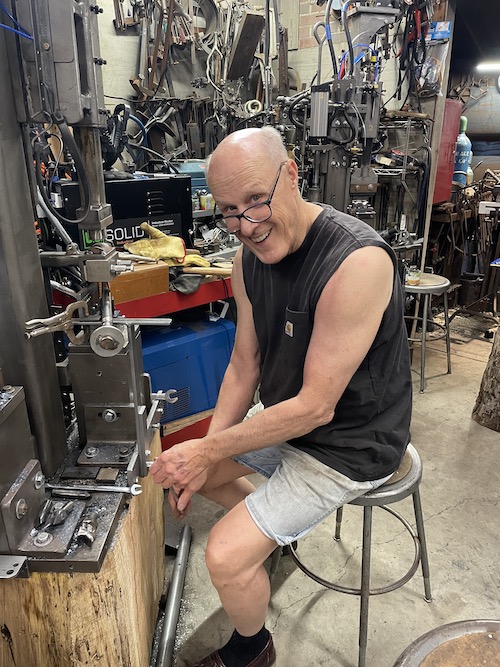
It has taken a decade for me to develop new forging techniques, but these techniques now allow me to make those delicate flowers. I can hot forge thin-walled tube into delicate, complex hollow forms, using a free-form method that allows many varied shapes to be forged using dies having a general design. Little did I envision that flowers would just be the beginning. Nature is loaded with hollow forms like seed pods, fruits and vegetables of seemingly limitless variety. It is inspiring. Equally inspiring is human world of arts and crafts. It is full of creative forms as seen in paintings, stonework, ironwork from the masters, jewelry, movies like “Alice in Wonderland” or “Avatar”— and as I discovered—textiles, especially embroidery. The creativity and imagination in embroidery is exceptional. But not until recently would I ever have thought of blacksmithing and embroidery in the same thought. I do now, and it has led me to develop new technical methods that lead to unique forms. As one example, two strings of disks are shown in figure 2. What an unusual form, one that I do not ever recall having seen, even in Nature. But the string of disks did not suddenly pop into my head. I was shown it by Ms Canby Robertson, a master embroiderer, in a picture of 1600’s English embroidery, in two dimensions of course. I was immediately engaged in making my interpretation of it. She and her craft have been an inspiration to me for creative ideas in steel that are derived from embroidery.
Earlier I referred to technical advances that I developed. There were two technical achievements that allowed me to forge the sculptures that follow. One advance was for me to think differently. I call it “thinking in tube.” The other advance was developing the hammers and tooling in collaboration with Mr Dave Hammer to forge tube.
Thinking in tube was the first advance. Hollow round tube forging is very different from forging solid bars, the usual material used in traditional blacksmithing. For forging tube, traditional blacksmithing methods often do not work. Tube moves differently under the hammer and anvil. Understanding that difference and learning how to master it requires a different way of thinking and has led to creativity and excitement. And on top of it all, it has been a delight to make these forms.
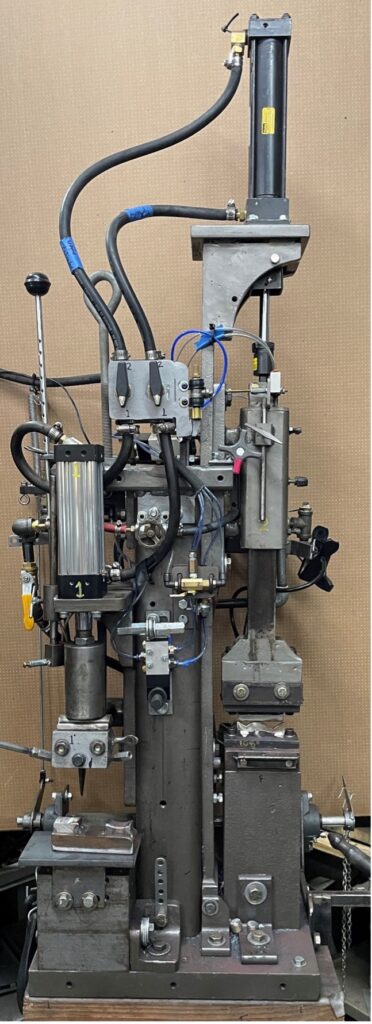
Hammers and tooling was the second advance. Precise air hammer control and special dies are necessary for tube forging. I use three custom air hammers built by Mr. Dave Hammer and hand-make all dies. These combine to make thin-walled tube forging easy to accomplish.
One might ask why take on this challenge, since most of us have thought that round, thin-walled hollow tubes are nearly impossible to forge in a typical blacksmith shop. One answer is simply that it was there for the challenge. Perhaps a more convincing answer is to show some examples. Each example that follows is composed of different flowers, bulbs, seed pods and some unusual forgings like the string of disks. Each tubular-shaped form is forged as a hollow forging. Flat elements are formed from sheet steel, bronze, copper-nickel and copper. Colors are applied mainly using children’s crayons and wax finishes.